Tuesday, April 26, 2016

Why Michelangelo?


I met Nancy Sanders, a talented children’s author, two years ago, through the popular 32 Authors Online Scavenger Hunt. We have since become friends and she has been a source of advice and even comfort in the difficult times of my life. At that time, I noticed she had written several interesting books for Chicago Review Press. Two titles were for their “For Kids” series of biographies, whose format seemed very similar to that of my Christian Biographies for Young Readers. 

I contacted the editors to see if they were interested in a title. Originally, I wanted to write a book on the Protestant Reformation, in view of the 2017 anniversary of Luther’s 95 Theses. They didn’t accept my proposal, but told me they had been looking for someone willing to write a book on Michelangelo.


Immediately, I saw many advantages in writing such a book. Michelangelo was Italian (so I could read his original writings), he lived during a time period I have researched in depth, and his works have an amazing depth that can enrich the lives of children. Also, I had a burning desire to present the Protestant Reformation and Roman Catholic response with clarity and accuracy.

On the other hand, I had to take many factors into consideration. First of all, art books require many images which are normally very expensive. Second, I have normally been writing for Christian families who may in some cases object to images of God and Christ, or to images of the naked body (like the David). On the other hand, you can’t talk about Michelangelo without showing those images.

I sought counsel from my pastors (Rev. Michael Brown and Dr. Rev. Michael Horton), who encouraged me to pursue this project, especially since it practically fell on my lap. You can’t teach children art history without incurring in images of God and Christ, or occasional nudes. Parents can avoid this subject altogether, or use judgment and wisdom in guiding the children in this field of learning.


Overall, I think this book will be useful to many children and families.

Monday, October 22, 2012

A Special Review


I love it when young people review my books. After all, they are written for them! This is a review written by  Katharine Olinger. Katharine is already a teenager, but still close to the book's target age and, as you will see, has great writing skills. This review was published in the November 2012 issue of New Horizons in the Orthodox Presbyterian Church and is reprinted here with the editor's permission.

I appreciate how Katharine pointed out her favorite aspect of the book. This type of reviews helps me to decide what features to emphasize or even omit from future titles. Thank you, Katharine!


Lady Jane Grey, by Simonetta Carr. Published by Reformation Heritage Books, 2012. Hardback, 63 pages, list price $18.00. Reviewed by OP member Katharine Olinger.
“Live to die, that by death you may enter into eternal life, and then enjoy the life that Christ has gained for you by His death. Don’t think that just because you are now young your life will be long, because young and old die as God wills” (p. 61). These were some of the last words of Lady Jane Grey—seventeen years old and facing execution.
In Simonetta Carr’s new book, Lady Jane Grey, the life of this young English monarch is painted clearly for the young reader, both figuratively and literally. It is not a black-and-white chapter book, but rather, because it is meant to be interesting to readers aged 7–12, it is thoroughly illustrated with vibrant paintings as well as photographs and sketches. And yet how could Jane’s story be suitable for young readers? She ruled for only two tumultuous weeks before being usurped by Bloody Mary, and six months later she was executed. Wouldn’t a story of success be a better guide for children growing in their faith? When Carr subtly addresses this issue, she does it well, pointing to Jane Grey’s own words and letters, such as, “Strive, then, always to learn how to die” (p. 62). Carr explains that Jane’s story “encourages many Christians with the thought that the same God who preserved and strengthened Jane’s faith until the end will do the same for all His children” (p. 54). 
My favorite aspect of Lady Jane Grey is the author’s use of original sources, such as Jane’s heartfelt letter to her sister. It’s one thing to read an account of her childhood and execution, but to read the dying advice of one sister to another, sisters by birth and faith, is quite another. This book would be a fine addition to any church or home library of one who is seeking to educate children in the way they should go, no matter what God intends for their lives.

Sunday, July 15, 2012

Correction


A correction for the upcoming Lady Jane book. On page 10, I said that, after Jane, Francis and Harry Grey had two more daughters and two sons. As far as we can tell by the documents available, this is wrong. They probably had one son named Henry before Jane, but he died as an infant, probably in his first year. There is also a possibility that Francis had a son from a second marriage. In any case, Francis and Harry did not have two sons together.
I was given this mistaken information by an expert who has since apologized for the confusion. I also apologize for not checking his information against other sources. It’s a good lesson learned, and this mistake will be corrected at the first available opportunity.
Just to let you know how I work, normally I send my manuscript to at least two leading experts on the specific character I am studying. When they send back their corrections, I insert them. If they seem to disagree with each other, I ask for further explanations. 
I have learned from this last mistake that I should check every single correction they send, unless they both send the same one. God willing, the quality and accuracy of these books will continue to improve.

Wednesday, June 20, 2012

Interview with William Boekestein

William Boekestein and I share much of the same vision and passion for teaching church history to children. He is the pastor of Covenant Reformed Church in Carbondale, PA, a father of three young and very bright children, and author of three books in a series for children about the stories behind the Reformed confessions (Faithfulness Under Fire, the Story of Guido Bres, The Quest for Comfort, the Story of the Heidelberg Catechism, and the upcoming The Glory of Grace, the Story of the Synod of Dordt). Recently I have had the pleasure to ask him a few questions about his thoughts and plans. Here are his answers.

1.     Some time ago, you wrote an article on appreciating church history ("Avoiding Chronological Snobbery"). How is church history important for children today?
             I was recently asked to speak to a local Rotary Club on the topic of “Turning obscure history into children’s books.” I told the audience that if this didn’t strike them as a stimulating topic…it gets worse. The books I have written are about obscure theological history. The “claim to fame” of the main characters in my books is that they wrote religious dissertations and catechisms! But I believe this kind (and other kinds) of church (and secular) history is important for children for several reasons.
       First, history is a great teacher. It provides greater perspective than our experiences allows. It provides negative examples of what we should avoid. We learn through our mistakes. But how much better to learn through the mistakes of others. History also provides examples of valor and courage. Fiction can do the same thing (and we love fiction!). But history can appeal more powerfully to our sense of reality. History also helps us to resist unhelpful fads by highlighting the tried and true.
      Second, church history is important for children because they need to know that ideas have consequences. The stories I have written describe a time when people were more honest about the significance of ideas. Sixteenth century folks would have laughed at the notion of ideological relativism. I do not endorse the extreme lengths to which people of varying convictions have gone to defend their positions. But we lie to children today when we say, “It doesn’t matter what you believe” or “all ideas are equal.” People in the sixteenth century agreed that what you believe about the mortality of man, the existence of God and the reasons for doing good really matter. The protagonists in these stories dedicated their lives to, and sometimes lost them in, defending ideas.
      Third, church history is important because Children better grasp ideas that are connected to people. Suppose you wanted children to catch a vision for Rotary International. You could try expositing to them the four guiding principles by way of explanation and application. But can you imagine a young child saying, “Please tell me more about, ‘The application of the ideal of service in each Rotarian's personal, business, and community life’?” Or you could tell them the stories of famous Rotarians like Admiral Richard E. Byrd, the intrepid Arctic explorer, the first to reach both poles by air, or aviation pioneer Orville Wright, or the famous founders of Walmart, Walgreens and J.C. Penny’s who were all active Rotarians. No doubt their stories would provide concrete and vivid expressions of service in action. If we want to teach our children of the importance of wholehearted service to God (as well as to man) we can tell the stories of people who modeled this devotion in a way that we might never do. Guido de Bres wrote, “Since we have the [awe] of God before our eyes…we offer our backs to the whip’s lash, our tongues to the knives, the mouth to the muzzle, and the whole body to the flames. For we know that whoever will follow Christ must take up his cross and deny himself.” He went on to practice what he preached. When children see hear of that kind of devotion illustrated in living color and written in words they can understand, it makes an impression.
       Finally, I believe church history is important for children because they need heroes who lose. Life is hard. And we do our children no service by only providing them with stories where everything works out nicely at the end. At the end of “Pollyanna” her rude aunt gets nice, marries her secret love interest, and Pollyanna overcomes a crippling accident by learning to walk again. We love “Pollyanna.” But that’s not always how life works. The protagonist in my first book, Guido de Bres, dies at the end of an executioners noose. Prior to that he was hunted by authorities simply for what he believed. Members of his own congregation were burned at the stake for their faith. In this particular story, I believe that Guido de Bres ultimately won. He had committed his life to the God who promises forgiveness of sins and eternal life for those who believe in him. But his life was hard.
       I would say that Church history is not only important for children today, it’s essential. Christianity is a historical religion. The great themes of the Bible (creation, fall, redemption, and restoration) are not merely ideas, they are real events that powerfully affect us. The Psalmist says, “I remember the days of old; I meditate on all your works; I muse on the work of your hands (Psalm 143:5; emphasis added). If we believe that God works in all of history then we need to introduce our children to this history. The previous verse says “One generation shall praise Your works to another, And shall declare Your mighty acts.” This is not a suggestion, it’s an expectation.

2.     Besides writing children's books on church history, what do you do to help your own children to appreciate our rich Christian heritage?
              We read a lot! We also try to do fun projects with our kids based on the books that they have read. I think it was in connection with your book on John Calvin that we made a quoits game (something Calvin apparently found time to play). The kids loved it!

3.     I asked one of my sons once what type of Christian books he appreciated most and he said, "The ones that actually teach me something." Your books for children are simple but don’t "dumb children down." They are historically accurate and talk rather straightforwardly about difficult times and profound doctrines. What are the challenges of writing serious and well-informed books for children?
             I think my greatest challenge in this area is remembering that I am not writing for myself. I am so thankful for the editorial work of others who seem to be gently but firmly telling me, “Remember, you are writing for children!” I hope that reading really good children’s literature helps overcome my inclination to write for adults when I am trying to write for children.

4.     In writing history, especially for children, an author is always forced to decide what to include and what to leave out. Can you give an example of one of your most difficult decisions in these regards?
             There are always so many interesting historical facts that have to be cut, especially from a children’s story. In my forthcoming children’s book on the Synod of Dort (October 2012, D.V.) one spread features William of Orange and his heroic leadership of the Dutch in their struggle against Catholic Spain. I think it’s an interesting fact that William, in exchange for leading the Dutch revolution, became one of the first leaders of state to be assassinated by a handgun. But considering strict word-count limits, as well as the difficulty of succinctly introducing concepts such as “assassination” to a young audience, this detail will probably be left out. Plus, some have felt that this series introducing the stories behind the reformed confessions has been to dark already, so why push it with another death reference!

5.     You have chosen to have full illustrations in your book. Can you tell us what are the advantages and the challenges of this choice?
             Since our intended audience for these books is somewhere between ages 3-9 we felt that full illustrations were a must. I think Evan Hughes has done such a great job in helping kids connect with the stories. The only real disadvantage to full illustrations is the cost. Even with Evan working for very reasonable rates (compared to industry standards) the costs are quite significant since the print runs are relatively small. I am personally grateful to the publishers for seeing this project through despite the heavy upfront costs and dubious prospects of fully recouping them.

6.      Your books introduce children to the Belgic Confession and the Heidelberg Catechism, telling the story behind those historical documents. This makes for an exciting read for many children who are raised in Reformed churches and are familiar with these documents. Have you received any comments from families who have never read these works but are now discovering them through your books?”
            One of the kind reviews of “The Quest for Comfort: The Story of the Heidelberg Catechism” begins this way, “Baptists do not tend to do catechisms. I don’t know why. We should.” The reviewer goes on to say, “This book aims at teaching ‘us that deeply held beliefs and profound theological truths are worthy of the difficulties often faced defending them.’ Our children need to know that.  They need to be brought up knowing that there are some truths that are so precious they are worth fighting and even dying for.  This book helps children to discover that our “quest for comfort” often follows a road filled with suffering, but God is faithful and His gospel is worth it.” (Read the full review at http://www.mikeleake.net/2012/02/quick-review-of-quest-for-comfort-by.html).

7.     Once you talked about an idea of a Christian children's authors conference. I think it's a fantastic idea because "iron sharpens iron," and if it is open to the general public we could cover many relevant subjects, including the importance of exposing children to good literature. I don't know if the idea will ever materialize, but what were you hoping to achieve with it?
             I think we are seeing some exciting developments in terms of Children’s writing from a confessional and reformed perspective. I am so thankful for the work of R.C. Sproul, Sinclair Ferguson, Starr Meade, Susan Hunt, and yourself, just to name a few. Still, if we compare the quality and quantity of books in this genre with children’s publishing in general it is clear that much more work needs to be done. Each year our family checks out several hundred books from the library. The number of good books on a myriad of topics and personalities never ceases to amaze me.
             I would love to see authors, church and school educators, pastors, parents and children (etc.) come together to encourage each other in the development and use of quality, biblical, books for children. Authors would have the opportunity not only to share their ideas with the audience but also to receive input. Educators and parents would be introduced to relevant books and encouraged with creative ways to use them. Such a conference might even help set events in motion which could lead to an endowment for reformed children’s books, something that would be an incredible boon for the genre.
Now that you have me thinking about it again, I’m more excited than ever! Maybe this could happen!

 8.     What are your future plans as an author?
I am in the final editing process with RHB for the provisionally titled, “The Glory of Grace: The Story of the Synod of Dort.” The artwork is just getting underway. I am also working on a devotional on the incarnation of Christ as well as a study guide on the Gospel of Mark which I hope to have published next year. I would like to write a story on the Westminster Assembly for children but since children’s books on deliberative assemblies are seldom best sellers it might be best to see how “The Glory of Grace” is received before proceeding. I have few other partly or mostly completed manuscripts that I would like to move forward with, when time and resources permit. 


Saturday, February 11, 2012

Striving for Quality

I am quite stubborn. It can be an advantage or a problem, so I have to keep it in check. So far, it has been mostly good. It has helped me to take the extra step when my body and soul were ready to give up. Sometimes, however, I have to evaluate those extra steps very carefully. What’s my motivation? Are they worth the effort and especially the cost?

I have done a similar re-evaluation a few days ago, when my illustrator raised his fees. It was a perfectly legitimate request. No illustrator of his caliber gets as little money as he does. He initially gave me low fees to help me out, but it’s time that he gets proper remuneration, especially since he has a family to support.

I don’t know if this is of any interest to others, but if you have appreciated the quality of the illustrations in the series of Christian Biographies for Young Readers, published by Reformation Heritage Books (RHB), you may want to know how they come about.

First, I must explain the financial side and my arrangement with RHB. Most people are surprised when they find that I have a publisher but I pay for my own illustrations and photos. The reason is simple. RHB is still a relatively small publisher, and the type and amount of photos and illustrations I have envisioned for these books is beyond most editorial budgets. Of course, there are large publishers who have the means to take on this type of projects, but initially they haven't shown any interest.

When I proposed my first book (John Calvin) to publishers, one very frequent objection was the cost. The first publisher I approached (a rather large Christian publisher) told me that for any company to consider this idea, it would have to be a small paperback book in black-and-white. That's why the illustrations in my first book are not in color. Eventually, they rejected the proposal even under those terms.

Other publishers made similar comments. One told me that I could not choose my own illustrator, and that they never pay much for illustrations anyhow. I don't know what thoughts inspired RHB to publish my books in color with a hard cover and an impeccable layout, but they did, and I am grateful for it. By contract, I am paying all expenses related to artwork and photos. Thankfully, they pay upfront and reimburse themselves from my royalties, otherwise I could never afford it.

There are, as I said, some Christian publishers who have the means to invest in high-cost productions, but they have to believe they will get appropriate returns. It has to make marketing sense. Again, at the time of my first proposal, a publisher told me that single biographies for children would never sell. A few others concurred. No explanation was given. They said it was just something they had experienced in the past. On the other hand, non-Christian biographies are selling fairly well. Why?

I am not a marketing expert and I am not ready to study this rather mysterious field, but one reason why children’s biographies which are not specifically Christian in nature sell well may be that they are backed by teachers and school librarians. On Martin Luther King Jr.'s day, for example, thousands of children throughout our nation are directed to libraries to read about this man. Some biographies are read in schools. Left to themselves, typical school-age children roaming through a library might be more prone to pick up a book about Captain Underpants, but parents and teachers often lead them to different choices.

If this consideration is correct, the question is, do parents and Christian-school teachers believe that biographies are important for children, and do they promote them? I think the homeschooling community is doing very well in this respect. My feeling (and I may be wrong) is that other parents and Christian school staff could do better. I have talked about the benefits of teaching Church history to children in another blog post.

This is where my stubborness gets evaluated. Why am I insisting on quality illustrations? Can I lower the standards? Are they really important? The answer boils down to my initial commitment to produce all-around quality books.

My initial motivation for writing this series, as I have mentioned in other blogs, has been the desire to see Christian biographies for children rise to the same standard I had been noticing in children’s biographies in general, which are constantly improving in quality, accuracy, fairness, and visual appeal.

Accuracy and fairness of course take the cake. Until recently, historical accuracy in children’s books has not been a major concern. In the 19th century, most biographies for children were largely fictionalized and had a strong message which took precedence over the actual retelling of facts. Today we see a much greater interest in accuracy, especially in the homeschooling community where these books are often used to supplement a serious study of human history.

Accuracy in Christian biographies is important not only to teach children what really happened in church history, without embellishments, exaggerations, or cover-ups, but also, in my view, as a way to inform non-Christians. I have already quoted Dr. Diarmaid McCullough, professor of the History of the Church at Oxford, as saying, "It seems to me that the history of Christianity is absolutely essential to talk about because there is so much bad history about it, and arrogance, conceit, dogmatism are all based on bad history." After all, understanding the history of Christianity is essential for anyone who wants to understand Western history and our present time.

To achieve the appropriate accuracy in my books I spend a year studying the subject and consulting experts, who normally read my manuscript and make comments and corrections. Even the illustrations are done under the advice of experts in the field, who have been amazingly gracious in answering all my questions.

Photos are important to show young children that these characters really lived, and we can still see the buildings they saw, the churches they attended, and even some of the furniture or other objects they used.

Art is important to spur the imagination and to keep the attention alive. Besides, since my books are very factual, illustrations give me a way to show what the feelings may have been or how some situations may have appeared to an observer, without having to interrupt my account of facts with too many “maybe’s" or “probably’s."

It’s true that I could just use lower-quality artwork, which would reduce the costs, but I think it’s too late for that. We have set the standard too high in every way. The only solution is to increase sales to be able to pay the illustrator. I believe the project is important and the products are well done. To increase sales I need to raise awareness, especially in schools and in the homeschooling community. Or we could go back to ancient times, when patrons sponsored artistic and cultural enterprises...

Monday, January 2, 2012

Weight of a Flame - Truth and Fiction (part 4)

Hopefully, this is the last part in my Truth and Fiction description of Weight of a Flame.

Chapter 14
What's true: The visit to the Sinapiuses, including Emilio's fall and the decision to take Theodora to Schweinfurt. Fanino's news are also true.
What's fiction: as usual, the details of the events. There is no indication that Francoise and Olympia went ice-skating, nor that Olympia was not good at sports. I added the scene to lighten up the gloomy progression of events, and I made her unsuccessful in sports because she excelled so much in her studies. It's true, however, that in one of her letters she applauded a young man for putting his studies over sports. The idea of ice-skating was also inspired by Bruegel's painting "Hunters in the Snow" (see detail here - uploaded from Wikimedia Commons).

Chapter 15
What's true: The news about Linz and Olympia's letter. It's also true that a group of scholars and believers met quite often at the Grunthlers' house to discuss books and Scriptures.
What's fiction: Again, the description of events. I omitted to mention that Olympia had a maid at that time, but the omission was just to keep the chapter simple and focused on the main event. Even with the maid, I am sure Olympia had to do quite a bit of work in the home, especially since in her letters she complained about the girl's disappointing performance and behavior.

Chapter 16-17
What's true: The siege, the plague, Andreas' illness, the cellar
What's fiction: Some of the details. We especially don't know what type of illness was this "plague".

Chapter 18
What's true: The escape, the itinerary, the imprisonment. Many events, including Olympia's reaction to the walk, are recorded verbatim from her description.
What's fiction: Some of the details

Chapter 19
What's true: The main story. It's also true that Elizabeth gave Olympia a dress.
What's fiction: Some of the details. We don't know how Olympia found out about her illness. We also don't know if she had bloody issues. Her description of her symptoms leads to think it was tuberculosis, so I wrote accordingly, but it's not certain.

Chapter 20
What's true: Jerome was really a student of Olympia. Much of the conversation is taken from their correspondence. It's also true that Olympia was invited to court. Some scholars have doubted that she was offered a position as lecturer of Greek at the university, but the appointment is mentioned in some documents written by her contemporaries.
What's fiction: Some of the details

Epilogue
What's true: Everything!

Happy reading!


Friday, December 30, 2011

Weight of a Flame - Truth and Fiction (part 3)


I am continuing the explanation of what is truth and what is fiction in my book, Weight of a Flame - the Passion of Olympia Morata.

Chapters 7-8
What is true - once again, the events are true. Olympia returned home, sometimes she met Andreas Grunthler, her father got better then worse, John Sinapius took care of him at first and then left for Germany. Finally, Fulvio died, Olympia returned to court and was rejected.
What's fiction - We don't know how any of those events really developed. I was especially trying to find how Andreas and Olympia met. In one of her later letters (after their wedding) she said, "I still love you. If I didn't, I would tell you, just like I used to tell you that I couldn't stand you." That gave me a clue. I imagined that during their first meeting she couldn't stand him for some reason.

Chapter 9
What's true - Again, the events are true. At some point, Olympia realized that she had lost sight of what is really important - the knowledge of God.
What's fiction - No one knows how that realization came to her. The letter she finds in a drawer is really a letter her father wrote to Curio, but there is no indication that she found it at this point. It's just a tool I used to develop the story.

Chapter 10
What's true - The main events and what is told about Fanini. The description of the prison is fairly accurate since I have visited the place, but of course I had to imagine how the same prison looked in the 16th century.
What's fiction - How the events developed and how the characters interacted. I also had to invent a way for Andreas to propose. A friend of mine who is a medieval history major told me that in those days men often proposed in writing, usually to the girls' father. Since Olympia's father had died, I imagined that the letter was addressed to her but Andreas asked for her mother's permission.

Chapter 11
What's true - The poem was really written by Olympia. The traveling plans are true, and Renée really gave some money and a wedding dress.
What's fiction - How the plans were formulated and presented to Olympia.


Chapters 12-13
What's true - It's true that Andreas went to Germany first, and then returned to take Olympia and Emilio with him. It's also true that Olympia missed him desperately. All letters are from her. The news Andreas gives are also true. The rendition of Psalm 23 is really Olympia's. It's also true that they stayed with Georg Hormann and visited the Fuggers (and the main description of the Fuggers and their financial empire is true).
What's fiction - I had to imagine Olympia's loneliness, Andreas' return, and then their trip. I actually used mapquest for parts of it! I had to also contact a Museum in Trento, a city on the border between Italy and Germany, to find how the roads had changed since then (I thank Dr. Giovanni Kezich, director at Museo degli Usi e Costumi della Gente Trentina for his kindness in answering my numerous questions). He was actually the one who suggested Olympia might have met a flock of sheep in transhumance, since it was summer (see photo). I also read Goethe's Italian Journey, where he talks about his experience crossing the Alps (he went from Germany to Italy and Olympia went from Italy to Germany, but more or less the experience was similar). About Olympia's meeting with the Fuggers, I don't know what really happened. I know that she had always wanted to give them her poems, but there is no mention of it after her visit. So I imagined what may have happened...

Photos: 1. Prison cell in the castle of Ferrara, by Massimo Baraldi, wikimedia
2. Sheep transhumance (seasonal migration), by Falken, Wikimedia

Weight of a Flame - Truth and Fiction (part 2)


Weight of a Flame - the Passion of Olympia Morata
Truth and Fiction (part 2)
Chapter 2 -
What's true - the description of the castle of Ferrara and the background information about Renée, Ercole, and the Duchy of Este.
Fun fact - some people asked me how to pronounce Ercole. Italians don't have a separate "er" sound, so you just pronounce the initial "e" as a short English "e". The accent goes on that "e". And of course you pronounce the last "e". Don't worry about rolling the "r". If you are totally frustrated, you can call him Hercules, because that's what the name means in Italian. But then, don't be offended if I translate your name into Italian next time I see you. All the names of Ercole's children and tutors are real.
What's fiction - the whole scene. I don't know how Olympia spent the first few hours at the castle.

Chapter 3 -
What's true - Everything the teachers said about Olympia and her talents. The poem is true. It's also true that some women were saying she needed to forget the pen and pick up some bed sheets.
Fulvio's suggestions on speech are from a letter to Olympia, including the Tite Tute Tati tongue-twister. By the way, my father taught me the same tongue-twister when I was a child, so I felt a strong connection there.
Olympia's speech on Cicero's Paradoxes is recorded and what I have quoted is taken from her actual words.
What's fiction - Again, the scene and her feelings. We do know that she was sick just before giving the speech, so possibly the tension was there.

Chapter four
What's true - The background story and the quote of the letter from Calvin to Renée.
What's fiction - How the events progressed. We have no indication of a conversation between Renée and Ercole that was overheard by Olympia, of a discussion between Olympia and Anne, nor of one between Olympia and Renée on the Mass.

Chapter five
What's true - It's true that Calvin mediated in the marriage between Francoise and John Sinapius. All the facts about Lavinia and Paolo, and about Renée's earlier marriage proposals are true. Olympia's poem about nuns is by her hand. It's true that she translated (probably with Anne) two tales from the Decameron. The whole story Curio tells here is true (according to his account of it). Her questions about prayer at the end are also true. We know she discussed these doubts with Lavinia but didn't work hard to find an answer.
What's fiction - again, the various scenes. For example, Curio's tale is true, but we don't know if Olympia asked him to repeat it for her and her friends.

Chapter 6
What's true - The whole papal visit is true, to the smallest details. Her letter at the end, praising the duke, is also true. This type of letters led me to infer some form of denial about any negative aspects at court.
What's fiction - We don't know what the pope said to Olympia (if anything). We also don't know if Olympia saw her mother and brother in the crowd.

Photos:
1. View of Ferrara from the top of the castle tower.
2. My kids on the drawing bridge in front of the castle.
3. My kids on a cannon behind the castle. I wonder if kids were allowed to do this back then.
4. A photo of a print in the kitchen of the castle. I think it's a floor plan.
5. My daughter pretending to be Renée of France in her chapel. The lighting is bad. The marble is white and black.
6. The Castle of Ferrara, by Massimo Baraldi, Wikimedia (all the photos above are mine)

Weight of a Flame - Truth and Fiction


As promised, I am beginning to write a list of what is historically true and what is a fruit of my imagination in every chapter of my book, Weight of a Flame, the Passion of Olympia Morata. I will start with the first chapter. Your comments are welcome!

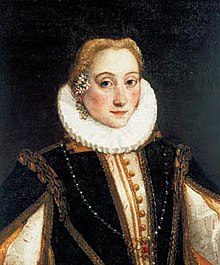
1. Cover - Olympia's looks on the cover are the fruit of the artist's imagination of Robert Papp. There is only one portrait available that depicts Olympia Morata. There she is much older, and we don't know for sure if it's an accurate portrait, so our artist has taken the liberty to take those basic features and come up with a younger Olympia.

2. Map - the map is quite accurate, between my knowledge of Italy and my map artist's (Tom Carroll) knowledge of Germany. Fun fact - we used mapquest for much of the route, including an approximate time of their trip (I chose "on foot" because the wagon probably traveled quite slowly). BTW, Tom Carroll did not get credit for the map, which was a sad oversight. We will remedy in the next edition. For the time being, please know that he has been very accurate and patient. It's not easy to find 16th century maps and retrace someone's steps.

3. Chapter One -
What's true - In 1539, Olympia went to live at the court of Duke Ercole and Duchess/Princess Renée of France. It's true that her parents were Fulvio Pellegrino Morato and Lucrezia Morata. The tailor's conversation about the duchess is based on reported facts. It's also true that Fulvio had to leave Ferrara for a while and had just returned. He was a teacher at the University and a tutor at the ducal court. And it's true that he wrote a book on colors and flowers (the quote is from the book) and taught Calvin's Institutes to his students on some occasions.
What's imagined - We don't know any of their personalities. We know nothing about Lucrezia. I deduced something of Fulvio's personality by his writings (letters and his treatise on colors and flowers). He seemed a little extravagant and pedantic, but in a letter to Celio Curione he manifested a great excitement for the Gospel. Did I capture who he was? Who knows? The tailor and his wife are a product of my imagination.
One note about clothes. Oddly, in Olympia's letter there is a recurrent interest in clothes. When she had to leave the ducal court, she was particularly upset that she was not allowed to take one of her dresses. In Germany, she describes a dress she received as a gift, even guessing its value. Even when she escaped the city, she took care to describe the ragged clothes she was wearing. I thought it was interesting, so clothes are mentioned here and there at key times in my book. You will find them here at the start and again at the close of the book.

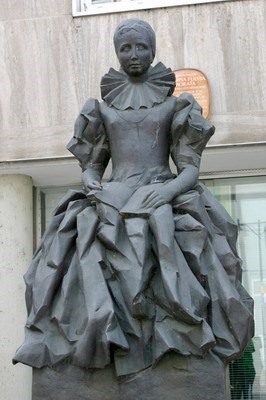
Photo1 - Statue of Olympia Morata at Schweinfurt, by www.waymarking.com
Photo2 - Portait of Olympia Morata, Wikipedia

Saturday, December 3, 2011

New Book Blog Tour!

Weight of a Flame
on blog tour


December 2011 - January 2012

Olympia Morata, arguably the most prolific woman writer of the Reformation, struggles to use her talents for God's glory despite rejection, religious persecution, and the hardship of illness, poverty, and war.

YA Biographical Historical Fiction

Click here for the publisher's description and read the first chapter and table of contents.


Tentative schedule.

Tuesday, December 13

Interview and giveaway

Thursday, December 15
Guest post

Thursday, December 29
Guest post

Friday, January 13
Review and giveaway


Tuesday, January 17

Wednesday, January 25
Review

Monday, January 30

Tuesday, January 31
Guest post and giveaway

Sunday, February 5
Review


Monday, February 13
Review

Saturday, February 18
Reviews

Monday, March 5

Review Giveaway

Wednesday, March 14
Interview

May 
Review

Thursday, June 29
Review


LATER REVIEWS

Saturday, November 19, 2011

Questions from Indonesia


Here are some questions I was asked during my seminars and talks in Indonesia. The title of the seminar was "Why Is It Important to Teach Theology to Children?" In some seminars, the word "theology" was rephrased as "doctrine."

Question - How can we teach doctrine to children if we don't obey the doctrine ourselves?
This question was asked at least three times (with different wording) during the different meetings. It seems that some had identified "doctrine" with rules and regulations. Since, from the start, I had used the catechisms (Heidelberg and Westminster) as main references for teaching doctrine, I explained how the Heidelberg catechism is divided into Guilt, Grace, and Gratitude, and Christian doctrine includes all three sections. The rules and regulations (do's and dont's) are part of the last section. We obey God out of gratitude for his grace, bestowed on us in spite of our guilt. The catechism also explains how we are all - parents and teachers - struggling against our sinful nature but are preserved by God through his Spirit.

This actually opened the door to more questions. When I gave the example of my son driving my car when he was four and watering my bed with a hose when he was three, and I explained how he was irresistibly drawn to all things forbidden, everyone's interest perked up. I actually brought up this story to explain how the Reformed faith changed my view of education. Before, I wanted perfect kids so I could look like a good Christian. Now, I know that my children and I are both sinners in God's eyes.

The next question after that was, How did you deal with him? I replied that recognizing the grip that sin had on this little guy gave me compassion for him. I punished him, of course, but I also talked to him heart-to-heart. We read Romans 7. I explained how I have similar struggles, but through Christ we also have the power to fight.

This led to more and more questions. Later, I was told that in Asia parents never confess their sins to their children (or in front of their children). They are supposed to provide a perfect sample and to expect perfect obedience. In further talks, I made clear that I also expect respect from my children, and that the distinction parent/child is very clear in our home. At the same time, in God's eyes we are equally sinners and fellow pilgrims in this valley of tears.

Question - Isn't doctrine too abstract for children?
This question also was rephrased in other ways. Isn't doctrine too dry, too difficult to grasp, not exciting? In this case, I referred to Michael Horton's explanation of the Story (or Drama) behind the doctrine. Doctrine is abstract and dry if it's not based on the Drama - the Story of God redeeming a people for Himself through Jesus Christ. We should always remember the story while we teach the catechism, and we may also remember the catechism as we teach the story. Drama and doctrine are tied together.

Question - How can we make doctrine exciting for our children?
This question is tied to the previous one, but many have asked this separately. Obviously, first we need to be excited ourselves. We need to always remember the drama behind it. As Dorothy Sayers said, "The Christian faith is the most exciting drama that ever staggered the imagination of man." We need to capture this excitement and pass it on to our children. Then the need to study doctrine, or theology, will be compelling. When we realize the wonder of the Gospel, this message of good news that is delivered outside of us and that is so foreign to our sinful nature, we want to know more just like a child who sees a rainbow wants to know how it's made.
Children are curious by nature. They usually have many questions about God but they don't always ask. The catechism helps to put some of those questions into words.
We all know that teaching doctrine CAN be dry. Some of us have experienced boring teachers or have at least seen them in movies (caricatures of this kind abound). While memorization is important, we don't want to limit our teaching to rote memorization. The questions help to engage the children. Think of the first question in the small catechism for younger children. "Who made you? God." It opens up a whole world of discussions between parent and child. The following questions then flow easily - What else did God make, and why? We can join our children in the excitement of discovery of what God has revealed, and in the sense of awe and mystery about what God has not yet revealed.

Wednesday, November 16, 2011

Practical Tips for Teaching the Catechism

(This is an article I wrote for the Outlook. It was published in the March-April 2011 issue. Since my lectures and discussions in Indonesia centered on the importance of teaching the catechism to our children, I am reprinting it here with permission from the editors of Outlook Magazine.)
See http://www.reformedfellowship.net/.

On the first Sunday this year, I opened with interest a small insert in our church bulletin. It was a plan for a full year of family worship. I was excited. My many years of homeschooling have left me with an instinctive appreciation of pre-made plans. I studied it carefully. On one side of the page there was a list of Bible passages, with the goal of reading through the whole New Testament in a year. On the other side, a list of catechism questions to memorize.

It didn’t look intimidating. The first few months are going to be especially easy. We know these questions already. As I turned the small pages, however, I realized that there will be new questions soon and, at that point, we will need a stronger commitment... and I was actually quite content to go without new resolutions this year!

I have lived through enough new year resolutions to know what a lasting commitment requires: a strong motivation, good planning, and lots of patience.


Motivation
I became absolutely convinced of the importance of catechisms several years back, during a casual conversation with a relative on the importance of reading the Bible. I was in the Orthodox Presbyterian Church (OPC) at that time, still fairly new to the Reformed faith, and was helping my children to memorize the Shorter Westminster Catechism.

In the course of our discussion, this relative asked me a familiar question, “What does the Bible teach?” Years earlier, I would have been fumbling for an answer. I might have given a generic reply, “It teaches about God,” most probably reinforcing his belief that he had already grasped that message. This time, instead, the answer came effortlessly, “It teaches what man is to believe concerning God, and what duty God requires of man.” (cfr. SWC, Q3)

His interest perked up. “What duty does He require?”

“Obedience to His revealed will, the moral law, which is summed up in the Ten Commandments.” (cfr. SWC, Q39-41)

As the conversation continued, covering man’s inability to perfectly keep the commandments and the answer to that problem, I realized that most of his questions were in the catechism, and I had answers - not only ready, but written and revised with amazing precision and care by godly men of old. Besides, these answers kept our conversation focused on relevant issues rather than generalities. More than ever, I wanted to pass on such an effective tool to my children.

Most of us are familiar with Dorothy Sayer's 1973 essay on "The Lost Tools of Learning," which decries the loss of clear answers and definitions in progressive education while advocating a return to the medieval trivium (grammar, dialectic, and logic). I see this loss quite frequently as an Italian instructor. While older students are a little rusty in their study and memorization habits, they have a tremendous advantage because they have studied grammar with its proper definitions. They can easily understand why the word molto, which means both “much” and “very”, changes its ending when it refers to nouns but is invariable when it refers to adjectives or adverbs. Their minds immediately relate to adjectives as modifiers of nouns and adverbs as modifiers of verbs, adjectives, and adverbs. When I talk in these terms they nod, while my younger students look absolutely puzzled.

I found the same need for definitions in my Sunday School class. A few years ago, when teaching 1st-3rd graders, I realized that in order to facilitate our communication and impress specific notions, I just had to use words like justification and sanctification, and the catechisms provided clear definitions. There was no way around them, just as a school teacher needs to explain to the class the definitions of "polygon", "triangle", and "equilateral", so that they can talk about an equilateral triangle without having to repeat each time that they are referring to “a flat shape with three straight lines, all of the same size.”

With the help of the catechisms, children can understand theological definitions quite simply. It is also reassuring to a parent or teacher to know that, when talking about realities like faith or providence, they and their children can have a common understanding of their meaning.

Katharine Olinger, a baptized member of Calvary OPC, Glenside, PA and an 8th grade student at Phil-Mont Christian Academy, shares a similar experience. "Catechism has indeed helped me in my life," she said, "especially my curricular one. As I attend a Christian school, I've found that during our Bible classes I'm always a step ahead of my peers and I can even impress my teachers with the catechism's well structured responses. In my spiritual life I more often refer to the Bible than the catechism, but I do particularly rely on the first question in the shorter catechism. It's comforting to have such a big question (what our purpose is) answered in black and white."

Marti Calderaro, a 16-year old baptized member of Chiesa Evangelica Riformata Filadelfia in Milan, a URCNA plant in Milan, Italy, agrees that the catechism is a great source of comfort. “It has helped me and my sister Erika to face not only difficult times in our lives, but also those our church is experiencing right now with the terminal illness of Elder Giuseppe Ferrari. It gives us comfort and helps us to share this comfort with our sister Ivana [Giuseppe’s wife].”

Marti began studying the Heidelberg Catechism about a year ago. She had never learned a catechism before, but didn't find it difficult. "It has been fairly easy, because our pastor, Andrea Ferrari, explains it very well."

Besides, learning the catechism as a family has other advantages. “It has set up an environment where theological questions come up naturally as we cover the various questions and answers,” said Roy Lopez, elder at Christ URC in Santee, California. “It has also deepened our love for God as we see all that He has done for us week by week. I believe it unifies us as a family, making us more of one mind (as it does for the church).

A Plan and a Method

We all know how quickly new resolutions become discarded when we don’t plan how to include them into our lives. That’s why the insert I found in our church bulletin is so helpful. The portions are well marked and within reach - a long catechism question or a few short ones every month. It's a very simple plan, and some families may choose to go beyond it.

While churches using the Westminster standards normally expect their children to memorize the Shorter Catechism in its entirety, it’s rare to find children who have memorized the entire Heidelberg Catechism, because of its length. Roy Lopez, however, has decided to challenge this trend. Last year, he has embarked on a three-year plan for memorizing the whole Heidelberg Catechism with his family.

“At the end of every year I try to plan what the family will do next in our devotions,” he explained, “something that can be done in one year. Several years ago we memorized Colossians which broke down into roughly two verses a week. It was great because we had the context and the rhythm of the whole passage. The Catechism seemed too long to memorize in a year (comfortably). So I went through all the questions and answers and broke them down into what I figured we could memorize per week. Sometimes it will be one or two per week and sometimes it will take two weeks to complete a long one. We mainly practice at night at the beginning of family worship but sometimes we practice in the car while we travel."

Roy has found that sharing the motivation with his family and coming to an united decision is very important before embarking on a long-term commitment. "I brought it up to the family and asked them what they thought about it. Everyone except Mikaela, our youngest, was enthusiastic about it. Mikaela, who is twelve, said that she didn't think she could do it. So, wanting it to be a free choice for everyone, I told her that we would be studying it and that she should just do the best that she can (no pressure). I didn't want it to become an empty ritual. Much to my surprise, she ended up being the one who was the most disciplined and is usually the one first to have the questions memorized. It started as a decision, then a discipline and it is now our habit."

Just the fact of memorizing together day by day, week after week, brings results. Some parents, however, have come up with creative ways to "spice-up" catechism memorization. Last Spring, I used it as penmanship practice,” explained Donna Link, a homeschooling mother of ten from Tacoma, WA, “by having the kids copy the questions and answers in a composition book.” Some have used the most comforting questions and answers as calligraphy practice, crafting beautiful gifts for their friends. Others use motions or put it into songs for the little ones.

Margaret Laning, a homeschooling mother of eight from Hull, Iowa, has a simple, well-known formula for success: "The main thing I found that works best is repetition, repetition, repetition, starting early in the week to get into the long-term memory work." She is, however, aware of her children's learning styles and tries to adapt her methods to make memorization easy for all. "Some are visual learners," she said. "For them, we have played a sort of 'erase the word' game on the computer. At first, we have the whole answer or verse typed out, and then gradually take a word away while they say the missing word. Eventually all the words are gone and they say the whole thing themselves."

"Some are more auditory learners," she continued. "I have a friend who had her kids record themselves saying the questions and answers on a tape or CD-recorder and then listen to it over and over. Doing both is great. Some other kids are kinesthetic/tactile learners. They seem to enjoy working with index cards. I have also heard of some cutting out footprints and writing parts of the lesson or verse on each foot, and taping it to the floor. The next part of the verse or lesson is on the foot ahead, and then another foot ahead of that. So, they read out loud the lesson as they jump from foot to foot. I have never tried that, but some younger children may really enjoy it."

There is a large variety of activities and games that can be used in catechism memorization. Often, it's possible to modify an activity or a game suggested for academic learning or for Bible memorization. My children and my Sunday School students have a few favorites. Once they mastered a catechism answer, for example, I asked them to say one word each, going around in circle. When one makes a mistake, he or she is out. This works well in large groups. Parents and teachers, of course, participate in the game, and they are often out sooner than the children.

A variation of this, still in large Sunday School classes, is dividing the class into two groups, and dividing the white board so that each group can go up and write one word of the catechism answer at a time. It's like a catechism relay race. To win, a team has to get the whole answer right, not just finish first.

Ideas to motivate and inspire the children are countless. Of course, there is always "candychism" (a word apparently coined some years ago by Rev. Leonard Coppes to describe the practice of rewarding children with candy for memorizing catechism answers). "I am not a big fan of 'candychism,'" Roy said. "I am not opposed to others doing it. It is just not something I would do. I guess it has a place with very small children. My philosophy is that I will pay my kids when they go above and beyond their chores around the house, not for spiritual things."

Katharine, on the other hand, loves the idea. "I wish my parents used candychism! They had the same kind of thought, only instead of little things for each question, they gave a big privilege for saying the whole Shorter Catechism in front of the session. For example, when I finished, I was permitted to get my ears pierced - something I had been wanting for quite a while."

The goal, however, is not only to motivate the children to memorize but also to help them to understand what they are saying, and that can be done, in small ways, even with younger children.

Being a logical thinker, I have usually tried to break down the catechism answers for the children, memorizing one section at a time, and sometimes drawing diagrams on the board to emphasize the organization and progression of thought. For example, in HC21, the first two sentences describe one part of faith, the next two another part, and the last sentence shows three things we believe God has given us, and three ways in which He has given them (freely, merely of grace, and only for the sake of Christ's merits). I have found this useful with the long paragraphs typical of Puritan writers.

To help the children to understand the meaning of difficult words, I have tried to use them repeatedly during the same lesson (or the same day, if we are at home). For example, since most children don't know the meaning of "merely," I explained that it means "only," and then used it often in my common interaction with the children, by saying, for example, "we have merely five minutes left."

"I try to relate each question to something that was said in a sermon or something that has happened to us recently or to the children in school," said Roy. "I definitely try to explain the importance of a proper understanding of each doctrine and any heresies that are opposed to that teaching."

Catechism vs. Scripture Memorization

The most common objection I have heard to teaching the catechism to young children is the obvious need to give a strong foundation of Scriptural knowledge. The concern is quite founded. Some Reformed children today are well versed in the catechisms and basic theology but are unfamiliar with biblical narrative and find it difficult to find passages in the Bible. What we often forget, however, is that the catechisms were never meant to be a substitute for Scriptures. On the contrary, they were to be used in synergy with a thorough study of the Bible, the preached Word, and pastoral instructions. In particular, the Puritans who wrote the Westminster Standards and the Three Forms of Unity were steeped in Bible knowledge, which permeated every facet of their lives, and they expected other Christians to be likewise.

For most of us who are far from the Puritans' devotions, striking a balance between catechism and Scripture memorization can be difficult, but it is again a matter of planning, including both in our family worship or Sunday School curriculum. In this respect, Roy has found Starr Meade's devotional book, Training Hearts, Teaching Minds, very useful, with verses to look up daily.

Memorizing the catechism is a great way to learn the doctrines of Scripture: it teaches theology in a very succinct way,” said Donna Link, a home-schooling mother of ten from Tacoma, WA. “Memorizing Scripture is also excellent and memorizing the catechism along with it gives a fuller understanding of what the different passages of Scripture are talking about.”

Used in synergy with the Bible, the catechism becomes all the more valuable. We can memorize Matthew 10:29-31 and Luke 21:18 and find comfort in the promise that every hair of our head is counted, or Romans 8:28 and know that all things work together for our good, but when we see those verses in the context of HC1, and are reminded that those same promises are given to us because we belong to Christ, in virtue of His sacrifice and in conjunction with the great benefits of forgiveness of our sins and deliverance from all the power of the devil, those words become much weightier and firmer in our minds.

This school-year, I have been teaching the trials, crucifixion, and resurrection of Christ to my 4th-6th grade Sunday School group, using the Heidelberg Catechism alongside each lesson, as an aid both to emphasize the overall importance and meaning of the Bible account and to notice the significance of often neglected details, such as the mention of Pontius Pilate in the Apostles Creed and the relevance of the cross as instrument of death.

Patience

One of the most comforting thoughts I have learned as a parent in a Reformed Church is that we are just to do what we are commanded and let the Holy Spirit work in our children’s lives. We take our children to public worship every Sunday, let them hear the preached Word, and prepare them to receive the Lord’s Supper. At home, we have times of family worship and learn the catechism together. It sounds reassuringly simple.

Whatever our plan may be for memorizing the catechism as a family, whether we set a very approachable goal of one or two questions and answers per month, to allow for the unexpected and to give more time to review, or we take up the challenge of memorizing it all, small steps are easier to maintain at a regular pace.

"We memorize a different line pretty much every day and by Saturday or Sunday we recite the whole thing together," explained Roy. "On Monday, we move on to the new question. I don't put pressure on us to go back and remember all the previous questions. I am happy if we can recite the answer at the end of the week and don't want to overburden my family by making too much of it. Some weeks are better than others, but we do the best we can."

With these affordable steps, Kristen Lopez, Roy's 13-year old daughter, has learned to enjoy memorizing the catechism. "At times it is hard because of different schedules and late nights," she said, "but it is always easy to catch up on Sunday."

Roy knows that it's important not to miss a week. "We may fall behind a few days but then I try to make sure we practice it more to be caught up by week's end. If we ever had to skip a week, I would continue with the program and just try to learn that portion later on. Of course, the memory work is much easier for the children than it is for Faith and me."

Faith Lopez, Roy's wife, agrees. "My motivation are my kids. They are so good at keeping up with their reading and memorization, it puts me to shame. It is very difficult for me and I struggle to find more time in my busy schedule and more space in my head for new information. I've had to make it a priority. It's just something that we do, part of our day. Besides, so many times God has used our memory work to encourage me. I would find myself in a particular struggle, and some words that I had memorized that week have come to my mind, helping me to reflect upon His love, grace and mercy towards me in my time of weakness."

By now, the Lopez family has discovered that their persistence had paid off. "What started as a decision has become a discipline and is now our habit," Roy said. Of course, there are still obstacles. From time to time, the motivation and discipline need to be rekindled. "Sometimes it feels like no one is motivated to do it, or we get especially busy, or the schedule is off for some reason, but that is where the discipline comes in. We continue to do it because we have set a goal and I have tasked myself with the responsibility to see that we get there."

Back from Indonesia

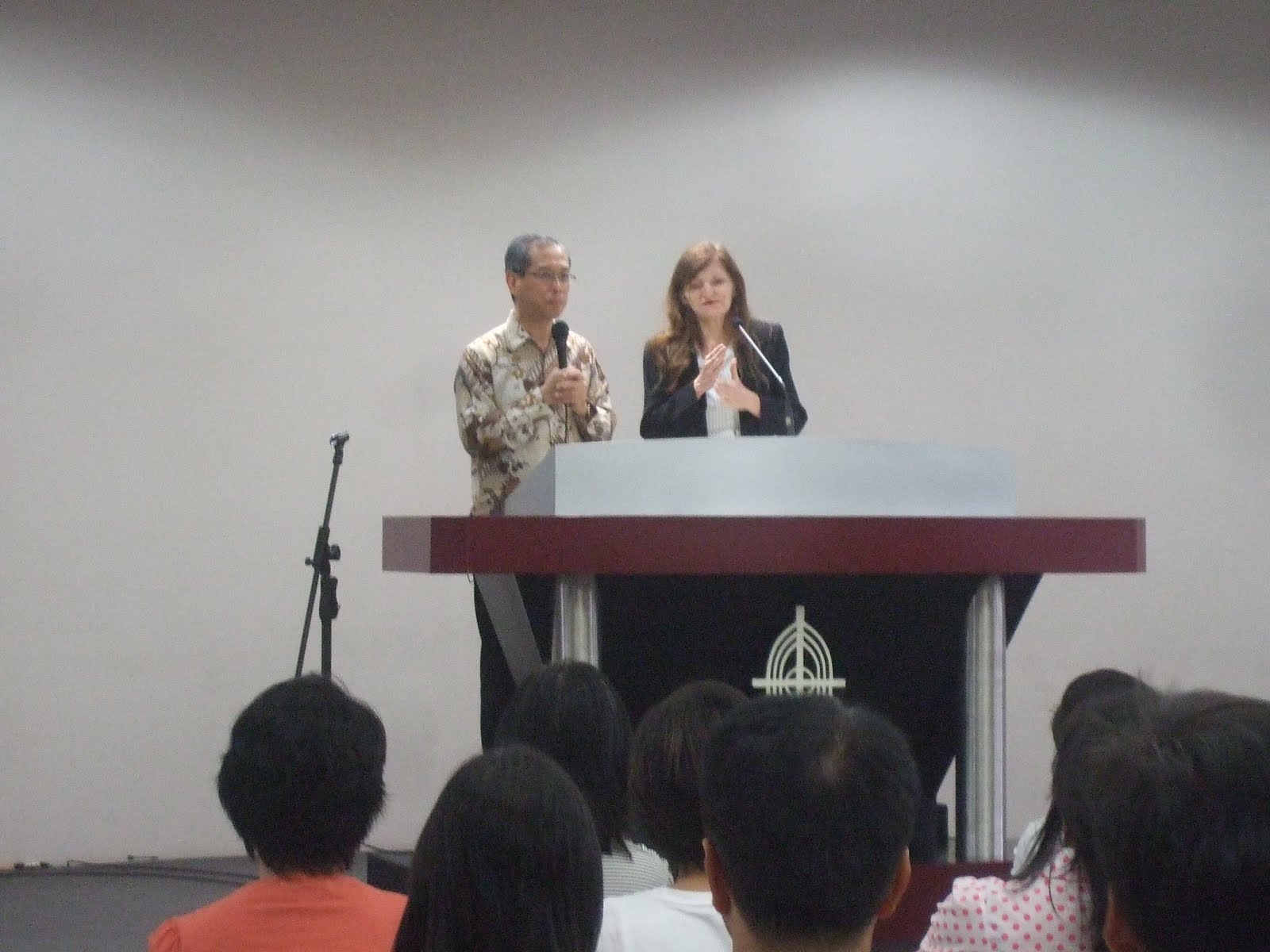
"Indonesia? What in the world were you doing there?" sometimes people ask. It all started in 2009, when I was searching the web for conferences on John Calvin so I could introduce my new book for children. It was then that I discovered a conference in Indonesia. I had been there, thirty years ago, and a piece of my heart was still in those islands. I sent Rev. Sutjipto Subeno, pastor and overseer of an international school and a publishing house, a copy of my book in English and he loved it! Soon after, it was in Indonesia and they committed themselves to publish the rest of my series. It was really the only foreign publisher to do so. My first two books have been published in Italian, but then they stopped because apparently they were not selling well.
In 2010, Rev. Sutjipto came to San Diego. It was a short-notice visit. He called me from LA the day before and I was only able to pick him up at the train station, take him to Santee, have breakfast at Starbucks and lunch with my husband, visit my church, pick up my kids from school, and take him back to the station. I felt like a very poor host.
My mother died in May this year. She died before I could go and see her so I canceled my trip to Italy. My emotions were pretty haywire at the time, and it was then that Rev. Sutjipto invited me to Indonesia, offering to pay almost all my expenses. I didn't think very hard. I emailed my husband who was at work, asking if I could go, and when he said yes I started to work on the tickets.
For a man, an invitation to speak at conferences and meetings might seem like work, but for a woman, it means no cooking, no cleaning, and no driving for two weeks! I was definitely excited. Soon, however, I realized that my schedule included talks in seminars, and the topic was "How to Teach Theology to Children." When I told my sixteen-year old son, his response was less than encouraging, "I didn't know you were an expert on that!"
My host told me to talk as a mother, and as a mother I shared how a sound theological education has benefited my children. I told them of my journey from evangelical churches where the children were in Sunday School instead of participating to the service, with very limited instruction, to a Reformed church where they were included in worship and were taught the catechism from a very young age.


I told them of my apprehensions when I first took my children to a Reformed church, wondering how they would adjust. But it was my son Jonathan, then about five years old, who told me that he actually liked the new church better, as he felt he was finally learning something! "In the old church, we just learn the same stories over and over," he said. It was Noah and the animals going into the ark, with an emphasis on the animals, and Joseph with the coat of many colors, with an emphasis on the colors. He was ready for more.
I have written on the benefits of teaching catechism in other articles, which I am hoping to post here. Overall, I think Indonesian parents were encouraged to see that the catechisms were originally written for children and can and should be taught to children.