Tuesday, November 16, 2010

The Good, the Bad, and Everyone Else

It's hard to sound impartial when writing a biography for children. It's hard enough to be impartial, almost no one is really 100% so, but it's especially hard to convey impartiality to children who seem to have an inborn, strong sense of right and wrong. Theologically, we say it's the Law written in their hearts.

Recently I read my manuscript on Athanasius to a Sunday School class (1st-3rd grades). In spite of my careful attempts to write an objective account, I realized that, after only a few paragraphs, they had already formulated some strong moral judgments in their minds. Athanasius was good - why else would I write about him? Alexander was good because he liked Athanasius. Arius was bad because Alexander disagreed with him. That was clear as soon as Arius died, because Olivia expressed her total dismay, saying, "Oh no! The good guy died and the bad man is still alive!"

Will it help to explain to the children that no heretic ever set out to bring wrong doctrine into the church? or that Arius was as sincere as Athanasius in his efforts to help Christians to have the correct idea of God and Christ, even if, as repeated church councils have convened, his teachings were not scriptural? How important is it to point it out? Should we let the children enjoy a little longer their oversimplified view of reality? Probably, unless the oversimplification is superimposed.

We all want to reduce things to black and white because we like it. We want a world well-defined that we can understand. But the truth is, there are more shades of grey than we thought and we are often afraid to face them. We need to be as impartial as possible in our instruction to our children.

I have recently read an article lamenting the lack of heroes in today's education. The truth is, we have plenty of heroes, they just uphold different values and are more flawed. As an Italian, I went through grammar school with glorious images of heroes of the struggle for Italian unity and independence. Today, Italian children learn the problems that a (possibly premature) unity has caused for the South. With the availability of internet research, children can learn with a click of a mouse the countless flaws of any heroes they may have been taught to admire.

Is this wrong? We can hold on nostalgically to a past populated with courageous heroes and grand gestures, or we can help our children to face reality. We wouldn't be the first generation in history to do that. The "heroes" of the Bible were mostly sinners from dysfunctional families, and yet there was a time when the Bible was read to children straight, and not filtered through cute children's books. The heroes of the true classics, like Odysseus and Achilles, were men struggling with their own passions and incongruities. Still, those are the characters that have mostly shaped my youth. Odysseus' obvious mistakes and misjudgments made him so much more relevant to me than the short heroic vignettes upheld to children as "role models", like Mutius Scaevola (a Roman legendary hero who burned his own hand to show what Roman bravery was all about).

The Hero of the Bible is God, from Genesis to Revelation. The Bible is not a book of inspiring stories of great men and women, but is the story, as my pastor often says, "of God redeeming a people for Himself through Jesus Christ." And so the history of the church, from Adam until now, is the story of God continuing to redeem and preserve His people, believers of all nations, simultaneously sinners and saints. Our children need to see God in history more than they need to see heroes, and they are more capable of understanding flaws, putting them in the right perspective, than we may think.


Monday, November 8, 2010

Editing Athanasius

I am having fun editing my book on Athanasius with some children at my church. Yesterday I visited the 1st-3rd grade Sunday School class and started to read the manuscript. Since I could not show the illustrations (not done yet), I drew pictures on the board.
They loved my illustration of Alexander watching Athanasius and his friends play on the beach. As soon as I started to draw some waves they told me I was a very good artist. There is nothing like the encouragement of a 7-year old. They also thought it was unusual to play "church" on a beach and wondered if Athanasius could baptize the other children "for real." They asked if the other children were his brothers and sisters.
When I started the theological explanation of Arius' doctrine, and how he said that if Jesus was God's Son, He had to have a beginning, the discussion became particularly interesting, as someone pointed out that Jesus was actually born. I explained that He was born as a man but not as God. When we hear Arius' formula ,"there was when He wasn't," we automatically understand it as referring to Jesus as God, but children don't, so I made note of that.
The intense discussion suddenly shifted when Adam declared solemnly, "I know why God is not married." He definitely got my attention.
"It's not that He cannot be married," He said, "but doesn't want to because that's the way He is. And He will never get married."
The highlight of the lesson was the hand Athanasius' enemies had brought in as a proof that he had killed Arsenius. Trying to be discreet, when I talked about the hand I pointed at a box, as if the enemies had brought it to Athanasius in a chest of some kind. That had the opposite effect, as Olivia asked me, her eyes wide open, "In our prize box?" I tried to reassure her, but she was not too sure and kept her eyes on the box carefully. "Is it still in the prize box?" she asked me later. This time I persuaded her that it was not.
Her brother Adam had the opposite reaction. His eyes shone bright as he heard of the severed hand. "A hand with blood gushing out? I have seen that hand!" Halloween was only a few days ago...
Sunday School ended there, but I am looking forward to reading the rest of the manuscript to the children. I could not write these books without them!

Sunday, October 3, 2010

When History is Unclear

Someone said, "When history is silent, folklore flourishes." I would add, "When history is unclear, imagination has a ball." At least that's the impression I get when I read some historical accounts...

Illustrating children's history books (or providing information to the illustrator) can present some interesting challenges. I mentioned some in an earlier post, when I was working on my book on Augustine. This seems to be particularly true when writing about a character who lived in the first millennium after Christ (or earlier), when history was not written with the purpose of presenting objective facts.
I have spent a couple of days researching two simple scenes - Athanasius, condemned by the Council of Tyre, flees to Constantinople where he hopes to convince the emperor of his innocence.
First, how does he flee? Most sources say that he left secretly by a raft under the cover of night (so Timothy David Barnes, Peter Brown, et.al.) Since my illustrator asked me for details, I started to think more carefully about it. Did Athanasius really travel by raft from Tyre to Constantinople? By himself? Did he even know how to navigate? How did he get there, following the stars?
OK, maybe the word raft meant something different. Maybe it was a small boat, and he paid someone to take him. Or maybe he took a small boat to reach a larger boat out in the sea.
I asked Dr. Giuseppe Corti, expert on patristics and author of a book on Lucifer of Cagliari, and he pointed out that sailors at that time would not leave during the night. OK then, maybe it was just before dawn. It makes sense. So the illustration will portray just that.
Next, he gets to Constantinople and apparently meets Emperor Constantine outside the city. We read that he had to wait for him because he was away. So we are faced with new questions?Where did the emperor come from? That would determine what he was wearing. Was he in a chariot or riding a horse? And Athanasius? How was their interaction?
In Athanasius and Constantius, by Timothy D. Barnes, we find an account of that meeting originally written by Constantine himself but reported by both Gelasius of Cyzicus and Athanasius, with some small differences. Athanasius tells us that Constantine was riding a horse. Good.
Then both writers go on to describe the exchange. They both mention that Constantine at first didn't talk to Athanasius. It seems that he didn't even recognize him and was surprised to find out that it was him. Gelasius says that Athanasius was "so humbled and cast down that we fell into unutterable pity for him." Athanasius omits that.
Was Gelasius right? Many other accounts (by modern writers) describe Athanasius as boldly approaching the emperor. One writer even says that he grabbed the reins of the emperor's horse to stop him. Was Athanasius bold or humbled? Should the artist show some pity on Constantine's expression or just surprise?
And why didn't Constantine recognize him at first? He had met him at least twice before. My guess is that Athanasius looked quite worn out and dirty after a long journey at sea and probably a long wait outside the city gates (he might have had to wait for a few days).
And about the expression, well, maybe he was pretty humbled and cast down, but also bold (in approaching the emperor and insisting to be heard). After a few hours, we see him threatening him that God will judge between the two of them. So we have a wide range of emotions.
Conclusion: I am leaving all this to the illustrator, confident that he will come up with the right expressions, clothes, and setting, and am moving on to further research for the next illustrations...

Friday, August 13, 2010

A New Name

I have changed the blog's name from Autosxedia (a Greek word found in a letter by Olympia Morata and translated as "words at random") to Imprints of Providence.
I started blogging as a way to keep people informed about my writings and a way to collect my thoughts. Over the course of time, I have been focusing more on the actual process of writing my Christian biographies for young readers, so a name change seemed in order. It is encouraging to see God's Providence at work in the history of His church, in spite of all the flaws and outright sins of the men and women He has chosen. My prayer is that my books will help our children to recognize God's loving hand as He continues to preserve His people and uphold His promise.

Tuesday, March 30, 2010

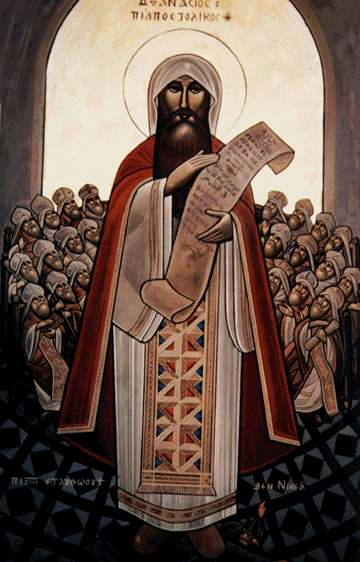
Athanasius - Hero or Heel

I decided to write a book about Athanasius (in my series of Christian Biographies for Young Readers) because I would like to give our children a historical and theological context to the Nicene Creed they often recite in church. As soon as I started my research, however, I realized that I was dealing with a very complex character and situation.
While some honor and venerate Athanasius as a courageous and self-denying saint, some think that he was nothing more than a self-serving violent politician. Of course, the truth is bound to lie somewhere in the middle. Or rather, as it is for so many characters of the past, the truth has to be viewed in the original context, free from the superimpositions of our own culture and our own modern views.
I must admit that, after seeing Athanasius compared to "a modern American gangster," (Timothy Barnes) I started to have some doubts. His theology is undoubtedly correct, but did he enforce it through violence and political schemes? David Brakke, in his article, "Athanasius", in The Early Christian World, tries to strike a happy medium between the two opinions. Still, it did not help me much to read, "The analogy of 'a modern American gangster' fails to capture this volatile combination of genuine religious conviction and brute political force, which may better be compared to that of a modern Iranian ayatollah." (Brakke)
"Athanasius' dual identity as saint and gangster stems from his more basic identity as a Christian bishop in the post-Constantinian imperially favoured chuch; the fourth-century bishop's roles as preacher, theologian, patron, and administrator render hopeless any modern attempt to separate 'religion' from 'politics' or 'thought' from 'action'." (Brakke) As so often happens, we have to let these characters "be men of their times."
All the characters in my previous books (Calvin, Augustine, and Owen) displayed a behavior which reflect the mindset of their times. Take Calvin and Servetus - most of us are ready to say that we would act differently in his shoes, but would we have really acted differently back then? Owen and the massacre of the Irish - how much could he do and how fully did he really approve or condemn Cromwell's actions? It seems rather that he accepted them as a necessary evil. And Augustine's approval of a government intervention against the Donatists has been widely criticized. After all, it was not too different from Athanasius' repeated appeals to imperial sanctions of a common doctrine and of one church.
Again, I find Brakke's insight very valuable: "If the resulting Athanasius seems less appealing than, say, the Augustine who sanctioned coercive actions against the Donatists, it is perhaps because, unlike Augustine, Athanasius has left us few glimpses of the inner life of a man burdened with such weighty responsibilities." We love Augustine in his Confessions. We even sympathize with him when, in a letter, he compares the unrepentant people who kept pestering him for justice to flies that he just wants to swat away. We are then ready to understand his position with the Donatists.
Finally, I decided to read Athanasius' Festal Letters, even if an expert thought they would not help me much. There, I immediately found a vibrant man full of love for God and His church. "Come, my beloved," his first letter starts, "the season calls us to keep the feast … so that, when time has passed away, gladness may not leave us."
I suddenly saw Athanasius as a young man, barely 30 years of age, suddenly invested with a position larger than almost any man could handle - the bishopric of the wide-spread area of Egypt and Lybia, full of disunity and strife - a position of utmost importance in his day, highly coveted, which came with immediate, unpleasant repercussions.
I saw aspects of his life and personality which I believe have been underplayed in his biographies (which normally focus on his defense of the full divinity of Christ). I understood his youthful passion and courage and his desire for innovation - trying to bridge the gap between the cities and the desert and bringing theological arguments to the level of the common man.
Then, providentially, I found a confirmation of my feelings in some writings by Charles Kannengiesser. "In such careful reading," he says, "the surprising fact begings to emerge that even in the more polemic Apologies, Athanasius is revealed as a pastor, much less interested in imperial politics than in the religious and spiritual education of his flock. If correctly noted, this primary concern reveals in all the Athanasian treatises and letters a vivid interest in the Bible and its use in a pastoral pedagogy" (C. Kannengiesser, Early Christian Spirituality).
(to be continued as I find out more about Athanasius)...


Monday, March 29, 2010

Vittoria Colonna

A couple of poems by Vittoria Colonna (1490 - 1547), translated from the original Italian.

WHENE'ER I LOOK AT MY SO GREAT AN ERROR

Whene’er I look at my so great an error,

confused, to God the Father I can’t raise

the unworthy face, but to You who for us died

upon the wood, I turn a faithful heart.

Your pain and love are today my shield

against a wrath that’s ancient and yet new.

You are my only true and precious pledge,

turning to hope and joy anguish and dread.


As Your breath left you, You prayed for us: "O Father,

let those who believe join me in my kingdom."

And now my soul at rest knows no more fear.

Now by Your mercy I believe, and know

Your burning Passion which razed all my guilt

forever, as it consumed You on the cross.


MADRIGAL

The white, sweet swan

dies singing, while I weeping

come to the end of life.

How strange and different our fate:

his death is without comfort,

mine full of blessing.

O sweet and gentle death,

to me more pleasant

than any joyous life!

O death which fills me

with great desire and mirth,

for, as the Phoenix,

I die but find new birth!

Tuesday, March 9, 2010

Funny Resemblance


Could there be a resemblance between John Owen (here on the right) and Robert Plant (top picture, right)? Or between Thomas Goodwin (here on the left) and John "Bonzo" Bonham (top picture, left)? You can be the judge.
(Thanks to Rev. Michael Brown and Dr. Carl Trueman for suggesting this thought).